Ph.D. Admissions Open 2026            |            Admissions Open 2026-27      
School of Arts & Science

Mathematics

Programme Overview

B.Sc. Mathematics

The Mathematics Programme provides a strong foundation in fundamental and advanced mathematical concepts, logical reasoning, analytical thinking, and problem-solving skills. It covers Algebra, Calculus, Differential Equations, Real Analysis, Discrete Mathematics, Statistics, Numerical Methods, and Mathematical Modelling with computational tools.

The Programme develops students’ ability to apply mathematical knowledge to real-world and interdisciplinary problems through practical activities, projects, seminars, internships, and experiential learning. It also promotes communication, teamwork, ethics, leadership, creativity, and digital skills .

The Programme prepares students for careers in teaching, data analysis, banking and finance, statistics, research, IT, government services, and other analytical fields , while encouraging higher education and lifelong learning.
Vision and Mission

UG Vision

Vision

To serve as a vibrant hub for mathematical excellence at the undergraduate level, inspiring curious young learners, logical thinkers, and analytical minds who master mathematical principles to solve real-world problems and contribute to scientific and technological progress.

UG Mission

Mission

01

To cultivate interdisciplinary collaboration, professional ethics, and leadership qualities among students and faculty for holistic development.

02

To offer inclusive, flexible, and interdisciplinary undergraduate programs in mathematics that integrate pure and applied concepts with allied disciplines, building graduates with strong logical reasoning, quantitative, and problem-solving skills for diverse career paths and lifelong learning.

03

To encourage foundational research and scholarly inquiry in mathematical theories, modeling, statistics, and computational methods, addressing key challenges in science, industry, education, and daily applications.

04

To expand access to quality mathematics education for rural and underprivileged students by connecting modern mathematical tools with traditional knowledge systems and developing practical competencies that support entrepreneurial opportunities and self-reliant careers.

05

To instill ethical values, social responsibility, and global awareness through hands-on problem solving, industry interactions, community projects, and experiential learning that links theoretical knowledge with real-world mathematical applications.

PG Vision

Vision

To serve as a vibrant hub for mathematical excellence at the undergraduate level, inspiring curious young learners, logical thinkers, and analytical minds who master mathematical principles to solve real-world problems and contribute to scientific and technological progress.

PG Mission

Mission

01

To cultivate interdisciplinary collaboration, professional ethics, and leadership qualities among students and faculty for holistic development.

02

To offer inclusive, flexible, and interdisciplinary undergraduate programs in mathematics that integrate pure and applied concepts with allied disciplines, building graduates with strong logical reasoning, quantitative, and problem-solving skills for diverse career paths and lifelong learning.

03

To encourage foundational research and scholarly inquiry in mathematical theories, modeling, statistics, and computational methods, addressing key challenges in science, industry, education, and daily applications.

04

To expand access to quality mathematics education for rural and underprivileged students by connecting modern mathematical tools with traditional knowledge systems and developing practical competencies that support entrepreneurial opportunities and self-reliant careers.

05

To instill ethical values, social responsibility, and global awareness through hands-on problem solving, industry interactions, community projects, and experiential learning that links theoretical knowledge with real-world mathematical applications.

PO, PSO, PEO

Programme Educational Objectives

PEOs

PEO1

Core Mathematical Knowledge

To provide graduates with a solid foundation in core mathematical concepts, theories, and techniques, preparing them for successful careers in teaching, data analysis, banking, and higher studies.

PEO2

Logical Thinking & Problem Solving

To develop logical thinking, analytical abilities, and problem-solving skills so that graduates can apply mathematical principles to investigate and resolve issues in science, engineering, and other domains.

PEO3

Professional Ethics & Teamwork

To foster professional ethics, effective communication, and teamwork that enable graduates to collaborate effectively and contribute responsibly to multidisciplinary environments.

PEO4

Lifelong Learning & Adaptability

To promote lifelong learning and adaptability, empowering graduates to keep pace with evolving mathematical applications and pursue advanced education or professional growth.

Programme Specific Outcomes

PSOs

PSO1

Mathematical Concepts & Problem Solving

Graduates will be proficient in applying fundamental concepts of algebra, calculus, differential equations, and discrete mathematics to model and solve theoretical and practical problems.

PSO2

Statistical & Computational Skills

Graduates will demonstrate competence in statistical analysis, numerical methods, mathematical software tools, and logical reasoning, enabling them to contribute effectively in data-driven roles, research support, teaching, and community analytical initiatives.

Programme Outcomes

POs

PO1

Disciplinary Knowledge

Demonstrate comprehensive knowledge and understanding of the fundamental concepts, theories, principles, and applications in the chosen discipline and allied fields.

PO2

Critical Thinking and Problem Solving

Identify, analyze, and solve complex academic, professional, and societal problems using logical reasoning, analytical skills, and evidence-based approaches.

PO3

Research and Inquiry

Apply scientific methods, research techniques, and investigative skills to conduct studies, analyze data, interpret results, and draw meaningful conclusions.

PO4

Creativity and Innovation

Develop innovative ideas, creative solutions, and entrepreneurial approaches to address contemporary challenges in academic, professional, and social contexts.

PO5

Digital and Technological Competence

Utilize appropriate digital technologies, software tools, and information resources effectively and ethically for learning, research, communication, and problem-solving.

PO6

Environment and Sustainability

Understand environmental issues and sustainable development goals and apply this knowledge to promote ecological balance and responsible resource utilization.

PO7

Ethics and Social Responsibility

Demonstrate ethical values, integrity, inclusiveness, and social responsibility while contributing positively to society and professional environments.

PO8

Teamwork and Leadership

Work effectively as an individual and as a member or leader of diverse and multidisciplinary teams, demonstrating leadership, collaboration, and interpersonal skills.

PO9

Communication Skills

Communicate effectively through oral, written, visual, and digital means with diverse audiences in academic, professional, and societal settings.

PO10

Employability and Entrepreneurship

Develop professional competencies, managerial abilities, and entrepreneurial skills required for employment, higher education, and self-employment opportunities.

PO11

Lifelong Learning

Recognize the need for continuous learning, adaptability, and self-development to meet evolving personal, professional, and societal demands in a dynamic global environment.

Programme Educational Objectives

PEOs

PEO1

Advanced Mathematical Knowledge

To provide graduates with a deep foundation in advanced mathematical theories, techniques, and computational methods, preparing them for successful careers in academia, research organizations, industry, and data-driven sectors.

PEO2

Advanced Analytical & Research Skills

To strengthen logical reasoning, analytical proficiency, and research aptitude so that graduates can formulate, analyze, and solve complex mathematical problems across pure, applied, and interdisciplinary domains.

PEO3

Professional Ethics & Collaboration

To instill professional ethics, effective communication, teamwork, and collaborative skills that enable graduates to work responsibly in multidisciplinary environments and contribute to knowledge advancement.

PEO4

Lifelong Learning & Professional Growth

To promote lifelong learning and adaptability, empowering graduates to keep pace with evolving mathematical applications and pursue higher research, teaching, or entrepreneurial endeavors in mathematics and related fields.

Programme Specific Outcomes

PSOs

PSO1

Advanced Mathematical Modelling

Graduates will be proficient in applying advanced mathematical concepts, theorems, modeling techniques, and computational tools to investigate and resolve theoretical and real-life problems in science, engineering, and finance.

PSO2

Data Analysis & Optimization

Graduates will demonstrate expertise in data interpretation, statistical analysis, optimization strategies, and mathematical software, enabling them to contribute effectively to research, industry projects, and community-oriented analytical initiatives.

Programme Outcomes

POs

PO1

Disciplinary Knowledge

Demonstrate comprehensive knowledge and understanding of the fundamental concepts, theories, principles, and applications in the chosen discipline and allied fields.

PO2

Critical Thinking and Problem Solving

Identify, analyze, and solve complex academic, professional, and societal problems using logical reasoning, analytical skills, and evidence-based approaches.

PO3

Research and Inquiry

Apply scientific methods, research techniques, and investigative skills to conduct studies, analyze data, interpret results, and draw meaningful conclusions.

PO4

Creativity and Innovation

Develop innovative ideas, creative solutions, and entrepreneurial approaches to address contemporary challenges in academic, professional, and social contexts.

PO5

Digital and Technological Competence

Utilize appropriate digital technologies, software tools, and information resources effectively and ethically for learning, research, communication, and problem-solving.

PO6

Environment and Sustainability

Understand environmental issues and sustainable development goals and apply this knowledge to promote ecological balance and responsible resource utilization.

PO7

Ethics and Social Responsibility

Demonstrate ethical values, integrity, inclusiveness, and social responsibility while contributing positively to society and professional environments.

PO8

Teamwork and Leadership

Work effectively as an individual and as a member or leader of diverse and multidisciplinary teams, demonstrating leadership, collaboration, and interpersonal skills.

PO9

Communication Skills

Communicate effectively through oral, written, visual, and digital means with diverse audiences in academic, professional, and societal settings.

PO10

Employability and Entrepreneurship

Develop professional competencies, managerial abilities, and entrepreneurial skills required for employment, higher education, and self-employment opportunities.

PO11

Lifelong Learning

Recognize the need for continuous learning, adaptability, and self-development to meet evolving personal, professional, and societal demands in a dynamic global environment.

Board of Studies

01

Dr. P. SAIKRISHNAN

Associate Professor
Department / Institution

NITT, Trichy

02

Dr. S. Kaspar

Associate Professor
Department / Institution

VIT, Vellore

Curriculum and Syllabus

UG Curriculum & Syllabus

B.Sc. - Mathematics

Curriculum and syllabus document for the undergraduate programme in Mathematics.

View PDF
PG Curriculum & Syllabus

M.Sc. - Mathematics

Curriculum and syllabus document for the postgraduate programme in Mathematics.

View PDF

Laboratory and Learning Resources

Faculty Achievements

Research Contributions

Paper Publications

01

Aiyared Iampan, Neelamegarajan Rajesh, J. Princivishvamalar “Bipolar Fuzzy Hilbert Algebras” Proyecciones Journal of Mathematics.

02

Aiyared Iampan, J. Princivishvamalar, C. Arivazhagi and Neelamegarajan Rajesh “Several Types of N-Fuzzy UP (BCC)-Subalgebras of UP (BCC)-Algebras” International Journal of Innovative Computing.

03

J. Princivishvamalar “Adaptive Feature Engineering for Identifying Spam Tweet Accounts Using Optimal Deep Learning Classifiers” IEE Explore- 2025 3rd International Conference on Data Science and Network Security (ICDSNS).

04

Manjumari M. “Decision Making Problem with Multiple Attribute Group Employing an Array of Singularly Perturbed Differential Equation”, Indian Journal of Science and Technology.

05

Manjumari M. “Singularly Perturbed Initial Value Problem for First Order Delay Differential Equation magdm Problem Using a magdm Problem”, Communication on Applied Nonlinear Analysis.

06

Manjumari M., & Indhumathi M. “Interpolation Approach for magdm Problems Using Intuitionistic Triangular Fuzzy Information at Uniform Nodal Points”, 3rd International Conference on Applied Mathematics and Bio-Inspired Computations.

07

V. Healn sinthiya, P. Malliga, R. Uma, P. Poomalai, “Radio Analytic Mean Graceful Number of Star and Bistar Related Graphs”, South Eastern European Journal of Public Health.

08

Malliga P, Dr. V. Helan Sinthiya “Radio Analytic Mean Odd Graceful Number of Star Cycle Graphs” International Journal of Computer Information Systems and Industrial Management Applications.

09

Malliga P, Dr. V. Helan Sinthiya “Application off Farey Edge Graceful Radio Analytic Mean Labelling Diameter 2 of Path-Related Graphs.

10

Malliga P, Dr. V. Helan Sinthiya, “Analysis of Drug Awareness Communication through the Radio Analytic mean labelling Using Oxide and Silicate Network graphs” International Journal of Drug Delivery and Technology.

11

Malliga P, Dr. V. Helan Sinthiya, “Farey Edge Graceful of Radio Analytic Labelling Cycle Related Graphs Involved Communicated Network Systems” Boletim da Sociedade Paranaense de Mathematical.

12

R. Ramya, V. Helan Sinthiya, N. Gomathi, “Characterization of Nano Regular Weakly Generalized Closed Sets in Nano Topological Space and their Real-Aife applications”, Multidisciplinary, Scientific Work and Management Journal.

13

R. Ramya, V. Helan Sinthiya, N. Gomathi, “Exploring Nano Regular Weakly Generalized *Closed Sets in the Context of Nano Topological Spaces”, Indian Journal of Natural Sciences.

14

R. Ramya, V. Helan Sinthiya, N. Gomathi, “A Structural Study of NRWG * Closed Sets via Homeomorphisms and Irresolute Mappings in Nano Topology”, International Journal of Aquatic Research and Environmental Studies.

Academic Contributions

Book Chapters Published

01

Dr. J. Princivishvamalar., The Role of Modular Forms and Elliptic Curves in Modern Cryptography, Current Approaches in Mathematics, IOT Academy Publishers.

02

Dr. M. Manjumari., The Application of Linear Algebra and Optimization in Machine Learning Algorithms”, Current Approaches in Mathematics, IOT Academy Publishers.

03

K. Kiruthika., New Algorithms in Numerical Analysis fast solvers and Spectral Methods, Current Approaches in Mathematics, IOT Academy Publishers.

04

K. Kavitha., New Approaches to Set Theory, Model Theory, and Proof Theory, Current Approaches In Mathematics, IOT Academy Publishers.

05

Saranaya, Complex Systems and Chaos Theory in Networked Systems, Current Approaches in Mathematics, IOT Academy Publishers.

06

R. Punitha., Key Mathematical Philosophies and M,ethodologies, Current Approaches in Mathematics, IOT Academy Publishers.

07

P. Malliga The radio analytic mean number of oxide and silicate network in the book titled Recent Trends in Mathematics.

08

R. Ramya Soft Topological Framework for Risk-Awake Drug Delivery Modeling in Breast Cancer with Pharmacokinetic Applications, GMR Academy Publishers.

Innovation & Intellectual Property

Patent

01

Dr. M. Manjumari, Dr. J. Princivishvamalar, A. Kiruthika., S. Punitha., K. Kavitha., Saranya., S. Amirthavarshini , “Real world-decision making problem with spdes based on MAGDM with intuitionistic and interval-valued intuitionistic fuzzy approaches”, Indian Patent Application, Publication No: IN202641056723A1.

Professional Development

Workshop

01

Dr. J. Princivishvamalar, National-Level Online Workshop titled “Harnessing & Mastering LaTeX with AI: Solve, Sketch & Generate – AI Tools for Next-Level Mathematics. April 15-17, 2026 organized by Indian Mathematics Professor Association and Infinity Research and Development Institute, Coimbatore.

Academic Events

Conference

01

Dr. M. Manjumari, International-Level Conference titled “International Conference on Applied Mathematics & Bio-Inspired Computations”. Feb 2026. Organized by PG & Research Department of Mathematics, Bishop Heber College, Tiruchirappalli.

Student's Corner

Student Achievement

Competition Achievement

Student

Ms. N. Pradeepa

Event Title

National-Level Symposium IGNITE ’26 – Mono Act Competition – First Place

Place

Dhanalakshmi Srinivasan Engineering College, Perambalur

Date

23.02.2026

Student Achievement

Competition Achievement

Student

Ms. M. Nithyasree

Event Title

National-Level Symposium IGNITE ’26 – Mono Act Competition – First Place

Place

Dhanalakshmi Srinivasan Engineering College, Perambalur

Date

23.02.2026

Student Achievement

Competition Achievement

Student

Ms. M. Nithyasree

Event Title

National-Level Symposium IGNITE ’26 – Just a Minute Competition – First Place

Place

Dhanalakshmi Srinivasan Engineering College, Perambalur

Date

23.02.2026

Student Achievement

Competition Achievement

Student

Ms. S. Lakshmi Priya

Event Title

National-Level Symposium IGNITE ’26 – Just a Minute Competition – First Place

Place

Dhanalakshmi Srinivasan Engineering College, Perambalur

Date

23.02.2026

Student Achievement

Competition Achievement

Student

Ms. S. Kaviyarasi

Event Title

National-Level Symposium IGNITE ’26 – Quiz Competition – First Place

Place

Dhanalakshmi Srinivasan Engineering College, Perambalur

Date

23.02.2026

Event Corner

12 AUG 2026
Event 01

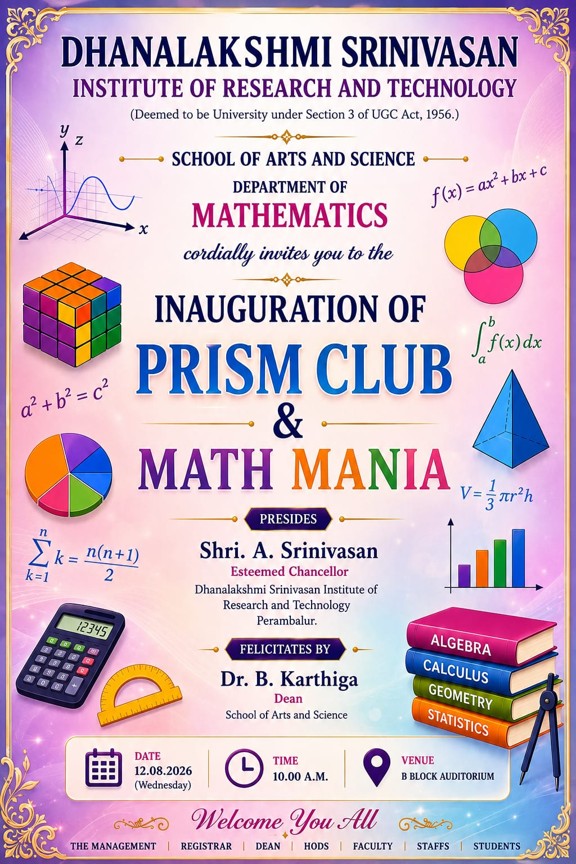
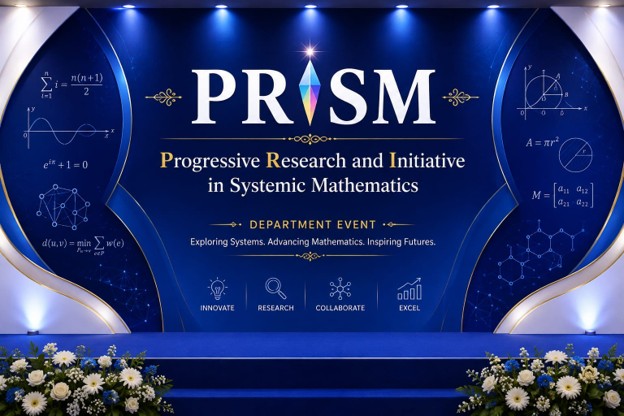
Inauguration of PRISM Club and Math Mania

Department of Mathematics

PRISM Club and Math Mania

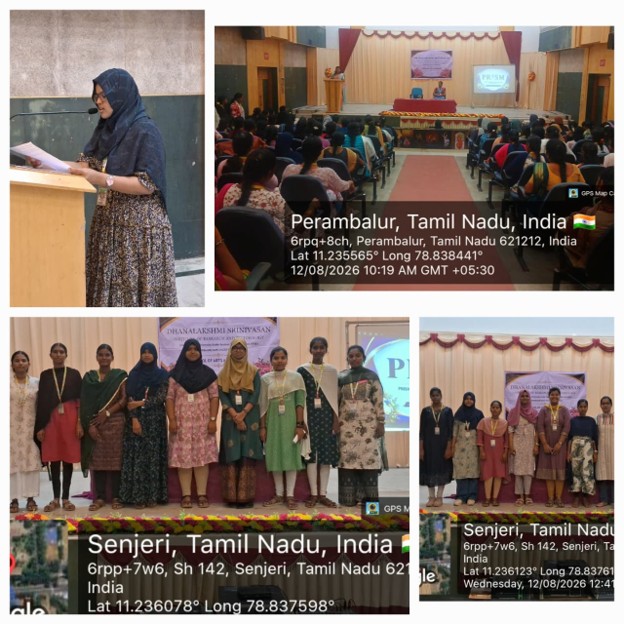
The PRISM Club was inaugurated as part of the Math Mania programme on 12 August 2026.

The programme was organized at the B Block Auditorium at 10:00 AM, with Dr. J. Princivishvamalar serving as the Resource Person.

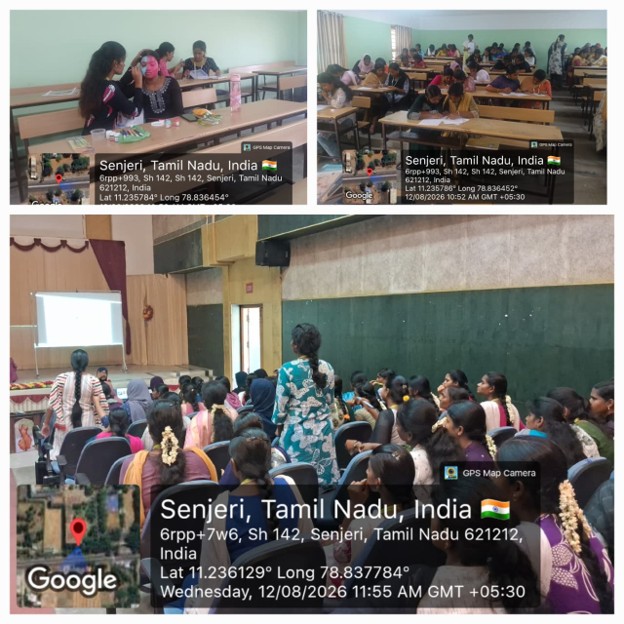
The competitions organized as part of Math Mania were:

01 Number Nexus
02 Connectix
03 Math Blitz
04 Mata Mosaic
05 Face Fusion

The Department of Mathematics, School of Arts and Science, Dhanalakshmi Srinivasan Institute of Research and Technology, organized the inauguration of Prism Club & Math Mania on 12 August 2026 (Wednesday) at 10.00 a.m. at the B Block Auditorium. The programme was organized with the aim of creating greater interest in mathematics among students and providing them with opportunities to develop their logical thinking, creativity, problem-solving skills, and mathematical knowledge.

The programme was presided over by Shri. A. Srinivasan Ayya, Esteemed Chancellor, Dhanalakshmi Srinivasan Institute of Research and Technology, Perambalur. Dr. J. Princivishvamalar, Head of the Department , felicitated the programme. Welcome address by P. R. Meenakshi, I-B.Sc., Mathematics.

The inauguration of Prism Club and Math Mania marked an important step towards making mathematics more interesting and interactive. The programme highlighted various areas of mathematics, including algebra, calculus, geometry, statistics, graphs, mathematical puzzles, and three-dimensional concepts. The activities were designed to encourage students to explore mathematics beyond the conventional classroom environment and to appreciate its practical applications.

The programme created enthusiasm and curiosity among the students and provided a platform for them to participate in various mathematical activities and competitions. It is expected that the Prism Club will continue to organize innovative events, puzzles, quizzes, projects, and other activities that will strengthen students' analytical and problem-solving abilities.

The inauguration of Prism Club & Math Mania was a successful academic initiative by the Department of Mathematics. The event emphasized the importance of mathematics in developing creativity, logical reasoning, and analytical skills. It marked the beginning of an engaging mathematical journey for the students and encouraged them to learn, explore, and enjoy mathematics in a meaningful way. Vote of Thanks by E. Raihana Farveen, III-B.Sc., Mathematics.

Club Name PRISM Club
Resource Person Dr. J. Princivishvamalar
Date 12.08.2026
Time 10:00 AM
Place B Block Auditorium

Alumni Testimonial

Shalini K
Department of English

SHALINI.K

GR-II POLICE CONSTABLE

Batch 2018–2021
Work Place Chennai
My College Experience

Ammu A
Department of English

Ammu A

FRONT END DEVELOPER

Batch 2017–2019
Work Place Bangalore
My College Experience

Lt K. Kasthuri
Department of English

Lt K. Kasthuri

ASSOCIATE NCC OFFICER

Batch 2017–2020
Work Place Perambalur
My College Experience