

UG Vision
Vision
To develop proficient language professionals, researchers and communicators with global perspectives.
Dhanalakshmi Srinivasan Institute of Research and Technology (Deemed to be University), Perambalur, Tamil Nadu
The BA English programme is designed to build critical thinkers and globally competent communicators through immersive study of literature, language, and contemporary media. Across six semesters, students engage with British, American, Indian, Postcolonial, and Asian literatures alongside applied courses in linguistics, criticism, and professional communication — building a foundation that is as much about ideas as it is about employability.
The curriculum blends literary depth with practical, industry-facing skills: creative and digital-media writing, translation studies, theatre studies, oral presentation, and an experiential internship component. Value-added courses in ethics, gender studies, environmental studies, and Indian knowledge systems round out a socially aware, ethically grounded education.
Graduates leave equipped to pursue higher studies, careers in publishing, content and media industries, corporate communication, or entrepreneurial ventures such as freelance writing and media agencies — supported by a curriculum that continually adapts to emerging communication technologies and global knowledge systems.
6 semesters · 44 courses · 141 credits
Core literature courses spanning British, American, Indian, Postcolonial & Asian traditions
18 disciplinary electives — from Shakespeare and Gothic Literature to Writing for Digital Media and English for Competitive Exams
Skill-enhancement tracks in Translation Studies, Theatre Studies & Oral Presentation
Internship-based Experiential Elective in Semester V
Value-added courses in Ethics in AI, Gender Studies, Human Values & Environmental Studies
Dhanalakshmi Srinivasan Institute of Research and Technology (Deemed to be University), Perambalur, Tamil Nadu
The MA English programme is designed to develop proficient language professionals, researchers, and communicators with a global outlook. Across four semesters, the curriculum moves from advanced literary study into specialised research training — equipping students not just to read literature critically, but to produce original scholarship and communicate it with authority.
Students engage deeply with Indian, Postmodern British, Postcolonial, and Subaltern literatures, alongside advanced linguistics, literary theory, and a dedicated course in Research Methodology & Publication Ethics that prepares them for doctoral-level work.
Electives extend into contemporary and interdisciplinary territory — Film Studies, Gender Literature, Queer Theory, Digital Humanities, Performance Studies, and Speculative Fiction — reflecting how the discipline is evolving alongside media, technology, and social change.
Skill-enhancement courses in academic writing, script writing, ELT methodology, and leadership round out the research focus with practical, employable capability. The programme culminates in a semester-long independent Project.
Graduates are prepared for doctoral studies, academic and research careers, publishing and media professions, and roles requiring advanced language, analytical, and communication expertise.
4 semesters · 26 courses · 90 credits
Strong research foundation: Research Methodology & Publication Ethics, Contemporary Literary Criticism and Theory, a single-author study (R.K. Narayan), and a capstone Project (9 credits)
Contemporary/interdisciplinary electives: Film Studies, Digital Humanities, Gender Literature, Queer Theory and Narratives, Speculative Fiction, Performance Studies
Internship-based Experiential Elective in Semester III
Skill-enhancement tracks in Advanced Academic Writing, Script Writing, ELT Methods, Leadership & Team Management
To develop proficient language professionals, researchers and communicators with global perspectives.
To provide advanced knowledge in literature, language and cultural studies.
To enhance critical thinking, communication and research skills.
To foster creativity, ethical values and social awareness.
To prepare learners for academic, professional and research careers.
To empower critical thinkers and globally competent communicators through immersive, diverse literary and linguistic studies.
To cultivate deep reading proficiency, literary interpretation skills and nuanced cross-cultural text analysis.
To foster advanced creative writing, elite public speaking, and professional corporate communication competencies.
To instill empathetic humanistic values, ethical awareness and gender-inclusive social perspectives through literature.
To introduce foundational digital media writing, content creation mechanics and academic publishing paths.
Graduates will apply language and literary knowledge in diverse academic and professional contexts.
Graduates will adapt to emerging communication technologies and global knowledge systems.
Graduates will demonstrate professional competence, ethical values and effective communication.
Graduates will pursue higher studies; build freelance writing, corporate publishing or media agencies.
Apply diverse critical theory lenses and stylistic frameworks to analyze complex socio-cultural literary texts.
Apply modern digital tools and research resources for language and literary analysis.
Demonstrate comprehensive knowledge and understanding of the fundamental concepts, theories, principles, and applications in the chosen discipline and allied fields.
Identify, analyze, and solve complex academic, professional, and societal problems using logical reasoning, analytical skills, and evidence-based approaches.
Apply scientific methods, research techniques, and investigative skills to conduct studies, analyze data, interpret results, and draw meaningful conclusions.
Develop innovative ideas, creative solutions, and entrepreneurial approaches to address contemporary challenges in academic, professional, and social contexts.
Utilize appropriate digital technologies, software tools, and information resources effectively and ethically for learning, research, communication, and problem-solving.
Understand environmental issues and sustainable development goals and apply this knowledge to promote ecological balance and responsible resource utilization.
Demonstrate ethical values, integrity, inclusiveness, and social responsibility while contributing positively to society and professional environments.
Work effectively as an individual and as a member or leader of diverse and multidisciplinary teams, demonstrating leadership, collaboration, and interpersonal skills.
Communicate effectively through oral, written, visual, and digital means with diverse audiences in academic, professional, and societal settings.
Develop professional competencies, managerial abilities, and entrepreneurial skills required for employment, higher education, and self-employment opportunities.
Recognize the need for continuous learning, adaptability, and self-development to meet evolving personal, professional, and societal demands in a dynamic global environment.
Graduates will apply advanced literary and linguistic knowledge in academic and professional contexts.
Graduates will adapt to contemporary communication technologies and emerging literary trends.
Graduates will demonstrate research excellence, ethical values and effective communication skills.
Graduates will pursue doctoral studies, professional careers and societal contributions.
Apply literary, linguistic and critical theories to analyze texts and cultural phenomena.
Apply modern research tools and digital resources for language and literary studies.
Demonstrate comprehensive knowledge and understanding of the fundamental concepts, theories, principles, and applications in the chosen discipline and allied fields.
Identify, analyze, and solve complex academic, professional, and societal problems using logical reasoning, analytical skills, and evidence-based approaches.
Apply scientific methods, research techniques, and investigative skills to conduct studies, analyze data, interpret results, and draw meaningful conclusions.
Develop innovative ideas, creative solutions, and entrepreneurial approaches to address contemporary challenges in academic, professional, and social contexts.
Utilize appropriate digital technologies, software tools, and information resources effectively and ethically for learning, research, communication, and problem-solving.
Understand environmental issues and sustainable development goals and apply this knowledge to promote ecological balance and responsible resource utilization.
Demonstrate ethical values, integrity, inclusiveness, and social responsibility while contributing positively to society and professional environments.
Work effectively as an individual and as a member or leader of diverse and multidisciplinary teams, demonstrating leadership, collaboration, and interpersonal skills.
Communicate effectively through oral, written, visual, and digital means with diverse audiences in academic, professional, and societal settings.
Develop professional competencies, managerial abilities, and entrepreneurial skills required for employment, higher education, and self-employment opportunities.
Recognize the need for continuous learning, adaptability, and self-development to meet evolving personal, professional, and societal demands in a dynamic global environment.
Pondicherry University
9443957744
drtmarx@gmail.com
Annamalai University
9443651171 / 7695974745
drskarthikenglishau@gmail.com
Curriculum and syllabus document for the undergraduate programme in English.
Curriculum and syllabus document for the postgraduate programme in English.
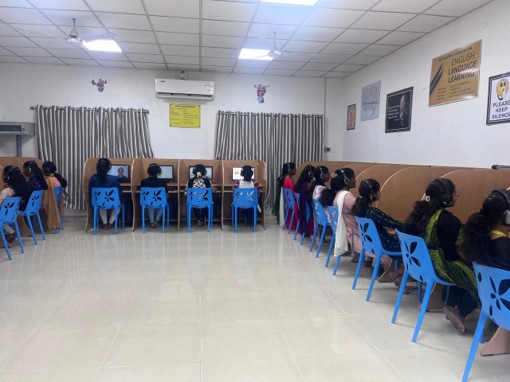
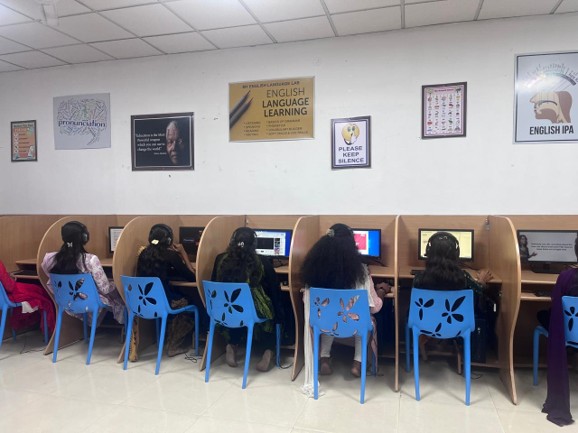
Our English Language Lab is a well-equipped, technology-enabled learning space with a seating capacity of 55 students, designed to enhance English language proficiency through interactive and practice-oriented activities.
The lab is equipped with 22 computer systems (20 AOC systems and 2 Acer systems) and Zebronics headsets, providing an effective environment for developing students’ listening, speaking, pronunciation, vocabulary, communication, and language skills.
The facility supports digital learning, audio-based practice, language exercises, and individual as well as collaborative activities, helping students develop confidence and competence in English communication.
Mrs. K. Bakyalakshmi awaits approval for a patent titled “Machine Learning in ESL: A Solution to Psychological, Social, and Pedagogical Challenges in Higher Education” on 24 April 2025. The invention focuses on the application of machine learning in English as a Second Language (ESL) education to address psychological, social, and pedagogical challenges faced by learners in higher education.
Dr. Radhika R contributed a chapter entitled “Emergence and Evolution of Indian English Short Stories” to the edited book Review on Short Stories in Indian English Literature . The chapter traces the origin, development, and evolution of Indian English short stories through various literary periods.
Ms. Uma Maheswari J contributed a chapter entitled “Contributions of Prominent Writers” to the edited book Review on Short Stories in Indian English Literature . The chapter highlights the significant contributions of prominent writers and their role in the growth and development of Indian English short-story literature.
Ms. A. Sowmiya contributed a chapter entitled “Narrative Techniques and Stylistic Features” to the edited book Review on Short Stories in Indian English Literature . The chapter discusses the various narrative strategies, literary techniques, language patterns, and stylistic features employed by Indian English short-story writers.
Ms. K. Ayesha contributed a chapter entitled “Virginia Woolf and The Inner Life” to the edited book English Novels and Stories in Modern Era . The chapter explores Virginia Woolf’s representation of the inner consciousness of characters, focusing on psychological depth, thoughts, emotions, and the complexities of human experience.
Pavithra R
III B.A. English
Tamil Speech Competition on Karmaveerar Kamarajar Birthday Celebrations
Secured 1st Prize in the Tamil Speech Competition.
School of Arts and Science for Women, Perambalur
15 July 2026
Department of English, School of Arts and Science
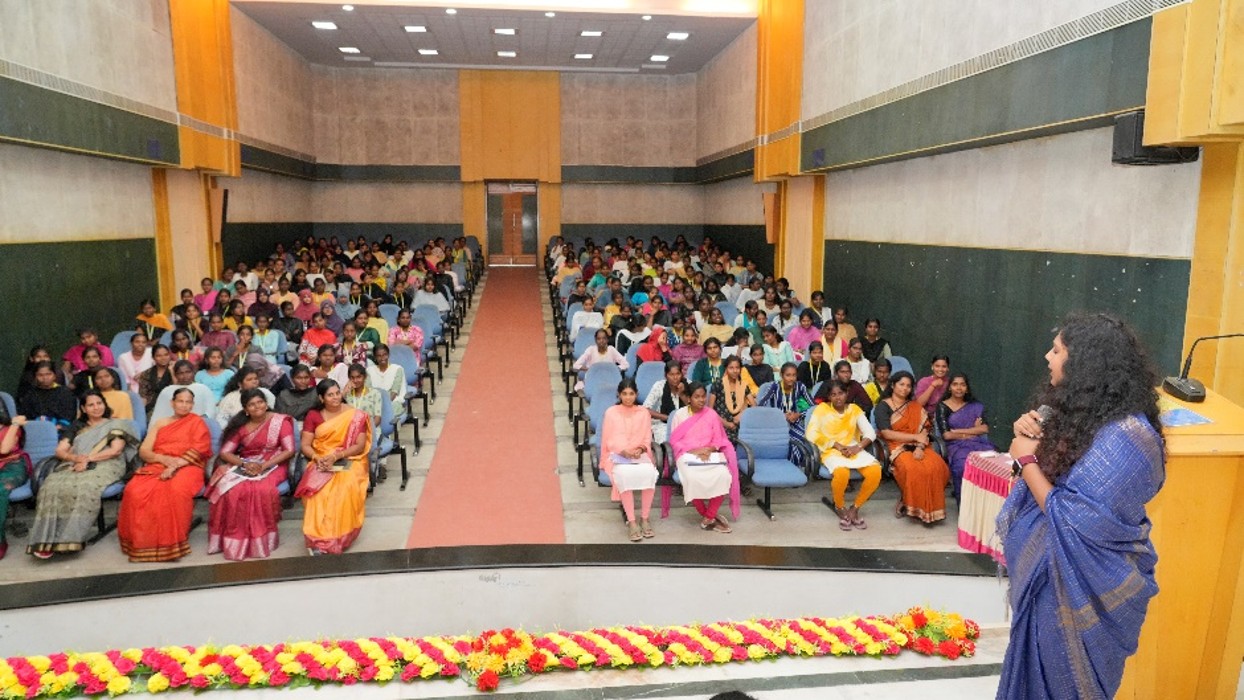
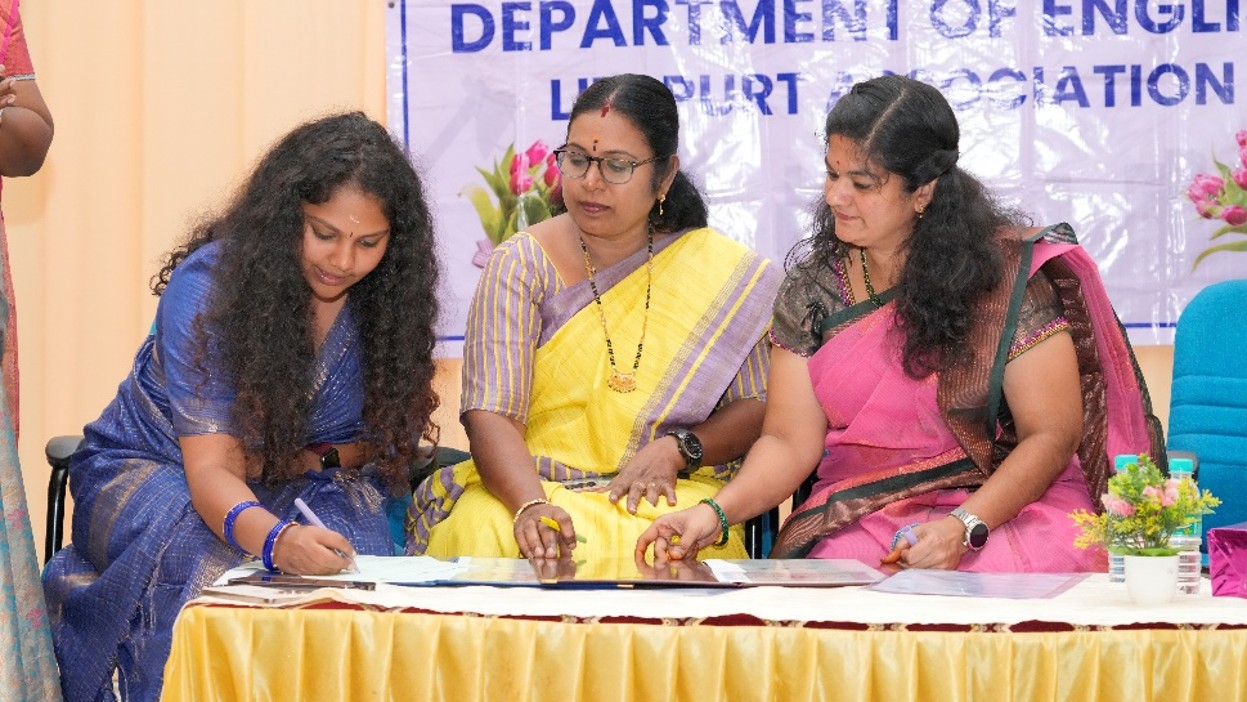
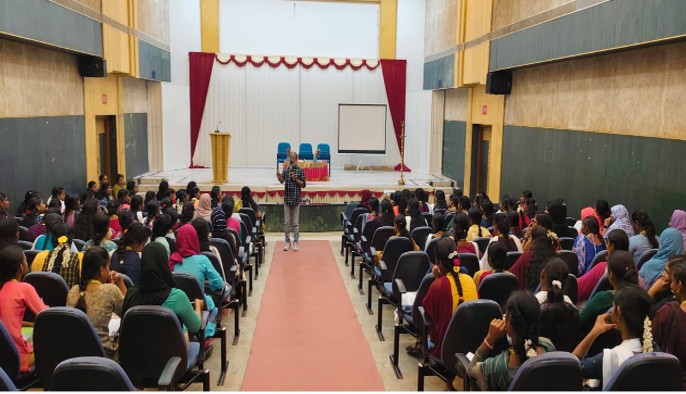
The Guest Lecture & MoU Signing Ceremony was organized by the Department of English, School of Arts and Science on 26 February 2026.
The programme featured an insightful guest lecture by Dr. R. Lakshmi Priya, Founder & CEO of PachydermTales – Literature and Art Foundation, Trichy, along with the formal signing of a Memorandum of Understanding (MoU).
CENTRE MANAGER